Why Smart People Stay Stuck: The Case for Trusting the Unknown
Intelligence is good at understanding problems. It's terrible at accessing the part of you that sees the truth when your head has assembled every reason why something wouldn't work.
Some of the most stuck people I've met are also the most intelligent.
They can analyze exactly what's wrong. They can see the patterns clearly, name the dynamics, describe the wound with precision. And then they do nothing. Or worse – they do the wrong thing, dressed up in very convincing logic.
That's the trap. Intelligence is good at understanding problems. It's terrible at accessing what I'll call inner knowing — the part of you that sees the truth when your head has assembled every reason why something wouldn't work. Some call it intuition. Some call it soul. Some call it the heart. The name doesn't matter. What matters is that it exists, and that the brain, on its own, can't get you to it.
What I learned on the floor
I didn't arrive at this insight cleanly.
I arrived at it broke, alone, crying on the floor. The person I loved most in my life was dying and refusing my help. I had no money for food. I had managed to isolate everyone around me through years of closing down, protecting myself, making very rational choices that all somehow led to the same place.
I was smart. I understood intellectually that something was wrong. I had been understanding that for years.
Understanding it hadn't moved me an inch.
At that point I did something I'd never done sincerely before. I prayed – not for rescue, but for instruction. I said: I know I've made a mess of this, but I genuinely don't know what I'm supposed to learn. Show me.
Three days later I had a job offer. The person who hired me became a friend and a source of support through the months that followed as my grandmother died.
I'm not telling that story as evidence of God. I'm telling it as evidence of what happened the moment I stopped relying on what I already knew and opened to something I hadn't seen before.
The brain's problem
Here's why intelligence can become the obstacle.
The brain operates on the known. It reaches back into previous experience and generates predictions, explanations, solutions – all of them built from what's already happened. When things go wrong, it looks for patterns it recognizes. It finds them. It recommends what it knows.
What it doesn't do is reach toward what it hasn't experienced.
So if what you've known is rejection, the brain recommends protecting yourself from rejection. If what you've known is that love comes with conditions, the brain builds an architecture for managing those conditions. It's very logical. It confirms itself constantly.
The problem is that your life lessons – the actual ones, the ones that move you forward – exist precisely outside the known. They're waiting in what you haven't tried, what you've been afraid of, what you've been carefully avoiding because the last time something like it happened, you got hurt.
The brain says: don't go there. The inner knowing says: that's exactly where you need to look.
What a closed heart actually costs
A wounded heart doesn't protect you. I believed it did, for a long time.
What it does is narrow your field of vision down to the width of your specific fear. Everything you see gets filtered through it. Everyone you meet gets interpreted through it. You're not reading the situation – you're reading your wound, and projecting it onto the situation.
From there, the options feel binary: blame others, or hate yourself. Neither leads anywhere. Both feel like understanding. Neither is.
The people who stay in that place – and I've watched this – don't become wiser. They become more isolated, more certain in a view of the world that's shrinking. Smart people are particularly vulnerable to this because they can build very sophisticated structures to justify the closed position. The reasoning gets more elaborate. The heart gets smaller.
That's the worst version of being intelligent: using your mind to rationalize your wounds rather than heal them.
What opening actually requires
Change requires something the brain can't provide: willingness to encounter what you haven't seen.
Not faith in a specific God or system. Just the willingness to stop betting exclusively on what you already know and trust that something outside your current experience might be available to you.
That's frightening specifically because it can't be analyzed in advance. You can't think your way to knowing whether it will work. You can only open and find out.
I've found the most direct path is usually the one that feels most uncomfortable. Face the pain rather than route around it. Listen to it rather than manage it. Stay open to the people around you rather than withdrawing precisely when withdrawal feels most compelling.
Not because it's pleasant. Because the withdrawal is the trap.
Every person who has hurt you was showing you a place in yourself that needs attention. Every trigger is pointing at something real. The direction is always inward.
The actual work
This is what I know now that I didn't know on the floor:
Pain is a signal, not a permanent condition. But it only becomes information if you're willing to hear it.
The inner knowing, when you can actually access it, sees more than the brain does. Not because it's smarter — because it isn't filtering everything through the history of what's already hurt you. It can encounter a person or a situation as it actually is, rather than as a version of what came before.
That access costs something. It requires giving up the protection. Letting the walls down not because it's safe, but because the walls were never actually keeping you safe.
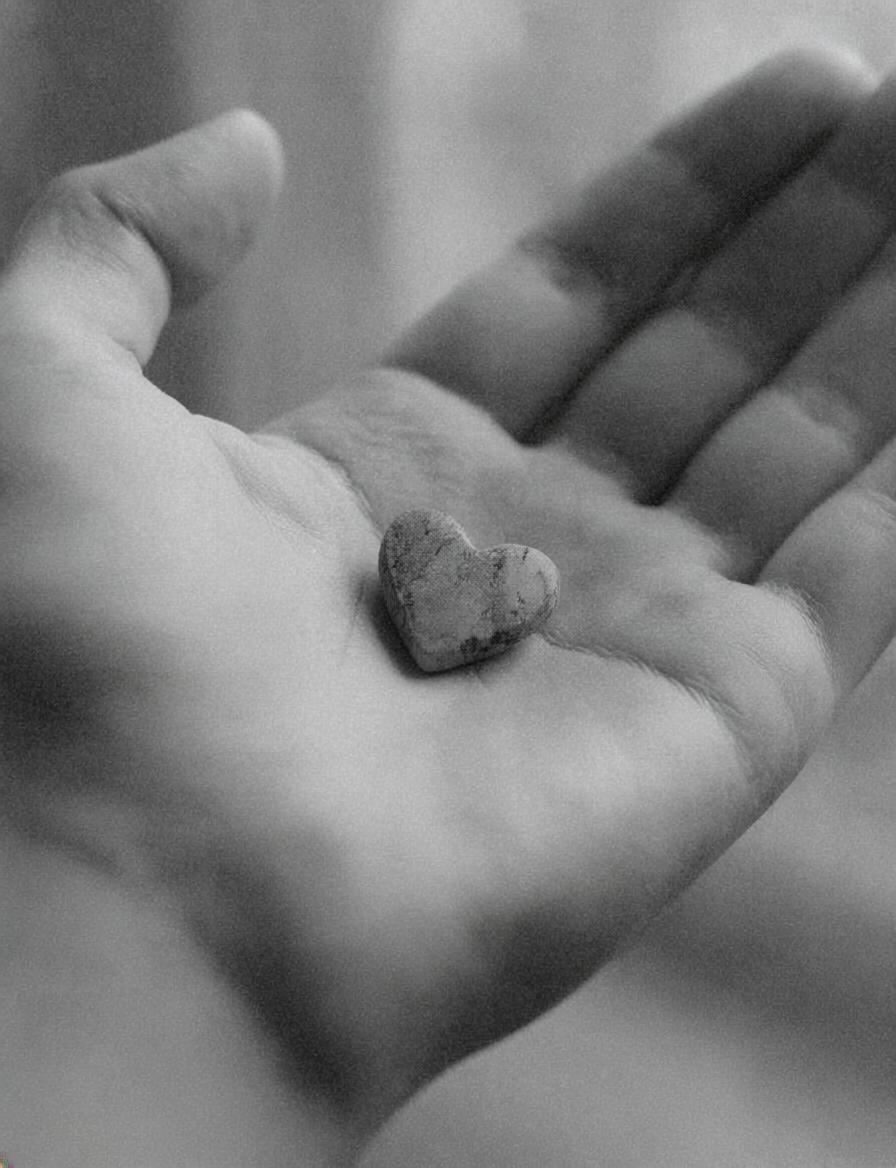
I wrote the word TRUST on a stone once, during a period when I had very little. I carried it around and when I saw it, I repeated to myself: I trust myself. I trust my path. I trust what I don't yet understand.
It sounds small. It wasn't small. It was the beginning of getting back to something I'd been locked out of for years.
The inner knowing is always there. The access is yours to open.
That's the whole work.